
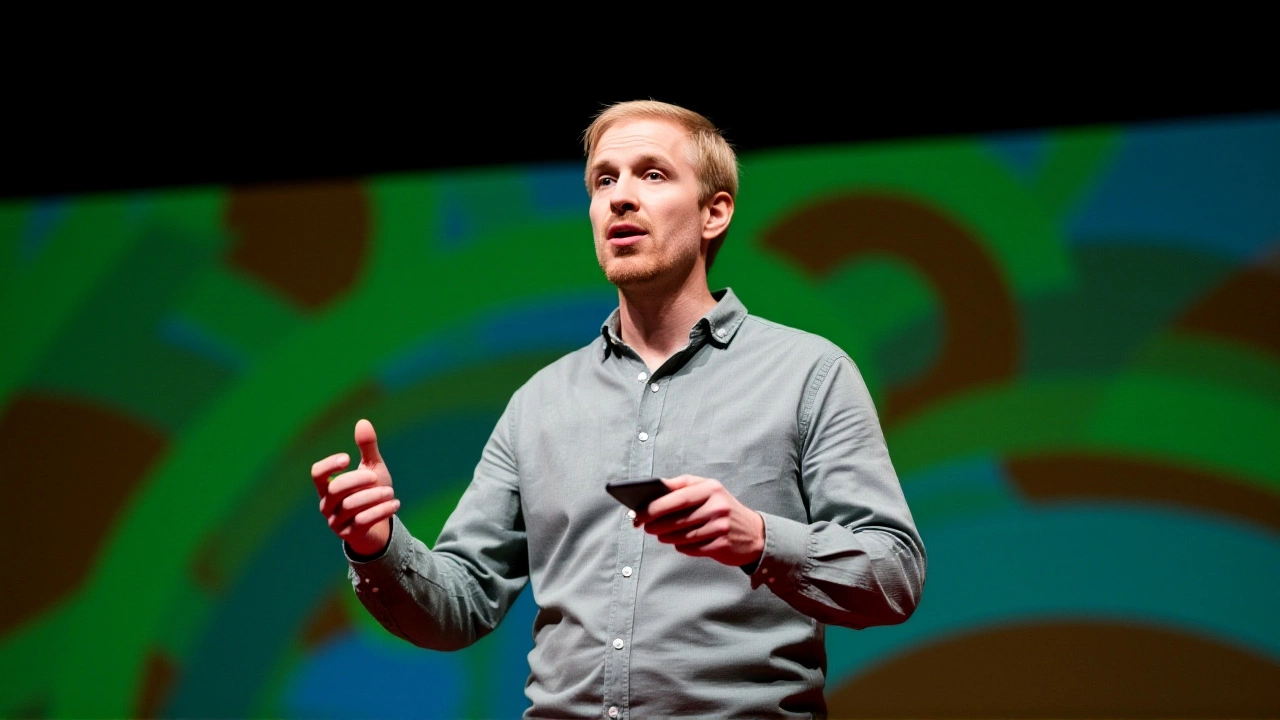
On January 23, 2019, Rutger Bregman, a 31-year-old Dutch historian and author, stood up in the plush halls of the World Economic Forum Davos and cut through the noise with three words: "Taxes, taxes, taxes." The rest? "All the rest is bullshit in my opinion." His blunt declaration — delivered during a panel at the Congress Centre Davos — didn’t just rattle the room. It exposed a gaping hypocrisy at the heart of global elite gatherings.
The Hypocrisy of Philanthropy
Bregman, attending Davos for the first time, was stunned by the disconnect. "1,500 private jets flown in here to hear Sir David Attenborough speak about how we're wrecking the planet," he said, "and yet no one talks about tax avoidance." He compared it to a firefighters’ conference where no one’s allowed to mention water. The billionaires in the room, he argued, were using charity as a PR shield — donating millions to causes while dodging billions in taxes. "We can invite Bono once more," he quipped, "but come on, we've got to be talking about taxes."
He pointed to the business models of tech giants and financial firms that profit from surveillance advertising, data exploitation, and offshore profit-shifting. "These people made their money by coming up with destructive financial products that only destroy wealth instead of creating it," Bregman said. Philanthropy, he insisted, shouldn’t be a substitute for fair taxation — it’s a distraction.
"America in the Past Taxed Its Rich More Without Harm"
Bregman directly challenged billionaire Michael Dell, who had earlier asked panelists: "Name me one country where a 70% marginal tax rate has actually worked?" Bregman didn’t miss a beat. "America in the past taxed its rich more without doing much harm to growth," he replied. He referenced the post-WWII era, when top marginal rates hovered above 90% — and the U.S. economy boomed. He cited Erik Brynjolfsson, MIT’s digital economy director, who had made similar points the day before.
He didn’t stop there. He brought up the story of an American warehouse worker forced to wear diapers because her employer wouldn’t allow bathroom breaks. "This is in the richest country in the world," Bregman said. "Don’t tell me about low unemployment. You’re not counting dignity."
The $170 Billion Leak
Supporting Bregman’s argument was Winnie Byanyima, Executive Director of OXFAM International. "We have a tax system that leaks so much," she said, "that allows $170 billion of money every year to be taken to tax havens and denied to developing countries that need it most."
That $170 billion isn’t theoretical. It’s enough to provide universal healthcare in sub-Saharan Africa. It’s enough to educate every child in South Asia. Yet, as Bregman noted, the conversation at Davos focused on micro-donations and voluntary pledges — not systemic reform.

Germany vs. America: The Real Economic Test
Bregman didn’t paint higher taxes as a punishment. He framed them as a stabilizer. "Capitalism, by itself, is a very unstable system," he told WBUR in February 2019. "You need laws and institutions to tame it."
He pointed to Germany, where labor protections are stronger and the welfare state more robust. "You also see that the stock market is on lower levels than in the U.S. And indeed, the rich are not getting all the benefits from growth over there." His point? A lower stock market might be a good thing — if it means workers finally share in prosperity.
He dismissed the fear that higher taxes kill innovation. "Look at Europe," he said. "Some countries have high taxes and high growth. Others have high taxes and low growth. The difference? How progressive the system is, how well it incentivizes work, and how much gets reinvested in pensions, healthcare, and unemployment benefits."
"If They Don’t Invite Me Back, That Proves My Point"
Bregman knew his words would be controversial. When asked if he expected to be invited back to Davos, he smiled. "It’s going to be a dilemma for them, isn’t it? If they invite me back again, I’ll just say the same thing: taxes, taxes, taxes. But if they don’t invite me, that will only prove my point."
His prediction was sharp — and prescient. In the years since, Davos has doubled down on "stakeholder capitalism" and "inclusive growth," but concrete tax reforms remain scarce. The World Economic Forum’s own Future of Jobs Report admitted that "increased tax revenues provide scope to enhance social safety nets." Yet, few of its members have supported the OECD’s global minimum corporate tax — a policy Bregman would have cheered.
What’s Changed Since 2019?
Not much — at least not at the top. While New Zealand’s Prime Minister Jacinda Ardern introduced a "well-being budget" that same year, tying policy to mental health and child poverty, the U.S. and U.K. have largely retreated from progressive tax proposals. The 2023 U.S. tax code still allows billionaires to pay lower effective rates than their receptionists.
Bregman’s speech wasn’t just a rant. It was a blueprint. He didn’t call for revolution — just common sense: close loopholes, enforce transparency, and use revenue to rebuild the social contract. The question isn’t whether it’s possible. It’s whether the powerful will ever let it happen.
Frequently Asked Questions
Why does Rutger Bregman say philanthropy is a distraction from tax avoidance?
Bregman argues that billionaire philanthropy often masks systemic tax evasion — for example, tech moguls donating to education while using offshore subsidiaries to avoid billions in corporate taxes. He sees it as reputation laundering: giving away 1% of wealth to feel good, while keeping 99% untaxed. OXFAM estimates that $170 billion lost to tax havens annually could fund global healthcare and education — far more than all private donations combined.
Has any country successfully implemented a 70% top tax rate?
Yes — the U.S. did, repeatedly, between the 1940s and 1970s, with top marginal rates exceeding 90%. Economic growth remained strong, and the middle class expanded. Sweden and Denmark also maintained high top rates (above 60%) through the 1980s without economic collapse. Bregman’s point: growth isn’t harmed by taxing the rich — it’s harmed by letting them hoard wealth while workers struggle.
How does tax avoidance hurt developing countries?
According to OXFAM, $170 billion leaves developing nations annually due to corporate tax avoidance and illicit financial flows. That’s more than double what these countries receive in foreign aid. It deprives them of funds for hospitals, schools, and clean water. Multinational corporations shift profits to low-tax jurisdictions like the Cayman Islands or Luxembourg, leaving local economies starved of revenue — even when they’re extracting resources or selling products there.
Why does Bregman say a lower U.S. stock market might be a good thing?
Bregman notes that the U.S. stock market is inflated by extreme wealth concentration — the top 1% own nearly 40% of equities. In Germany, where taxes are higher and worker protections stronger, the stock market is lower but more stable, and wages grow faster. A modest decline in U.S. markets could mean wealth redistribution: more pay for workers, less for shareholders. That’s not economic collapse — it’s correction.
What did Bregman mean by "you're not counting dignity"?
He was referring to the story of American warehouse workers forced to wear diapers because they’re not allowed bathroom breaks during shifts. High employment numbers don’t reflect this reality. When companies cut costs by denying basic human needs, unemployment stats lie. Bregman’s point: economic success isn’t measured by GDP or stock prices — it’s measured by whether people can go to the toilet without fear.
Has the World Economic Forum changed since Bregman’s 2019 speech?
Rhetorically, yes — they now talk about "stakeholder capitalism" and "inclusive growth." But concrete action? Minimal. The global minimum corporate tax rate of 15%, agreed by 140 countries in 2021, is far below what Bregman and economists like Joseph Stiglitz recommend. Many Davos attendees still use tax havens. The forum hasn’t cracked down on its own members — and that’s exactly what Bregman warned would happen.